What Is OCR AI? A Plain-Language Guide

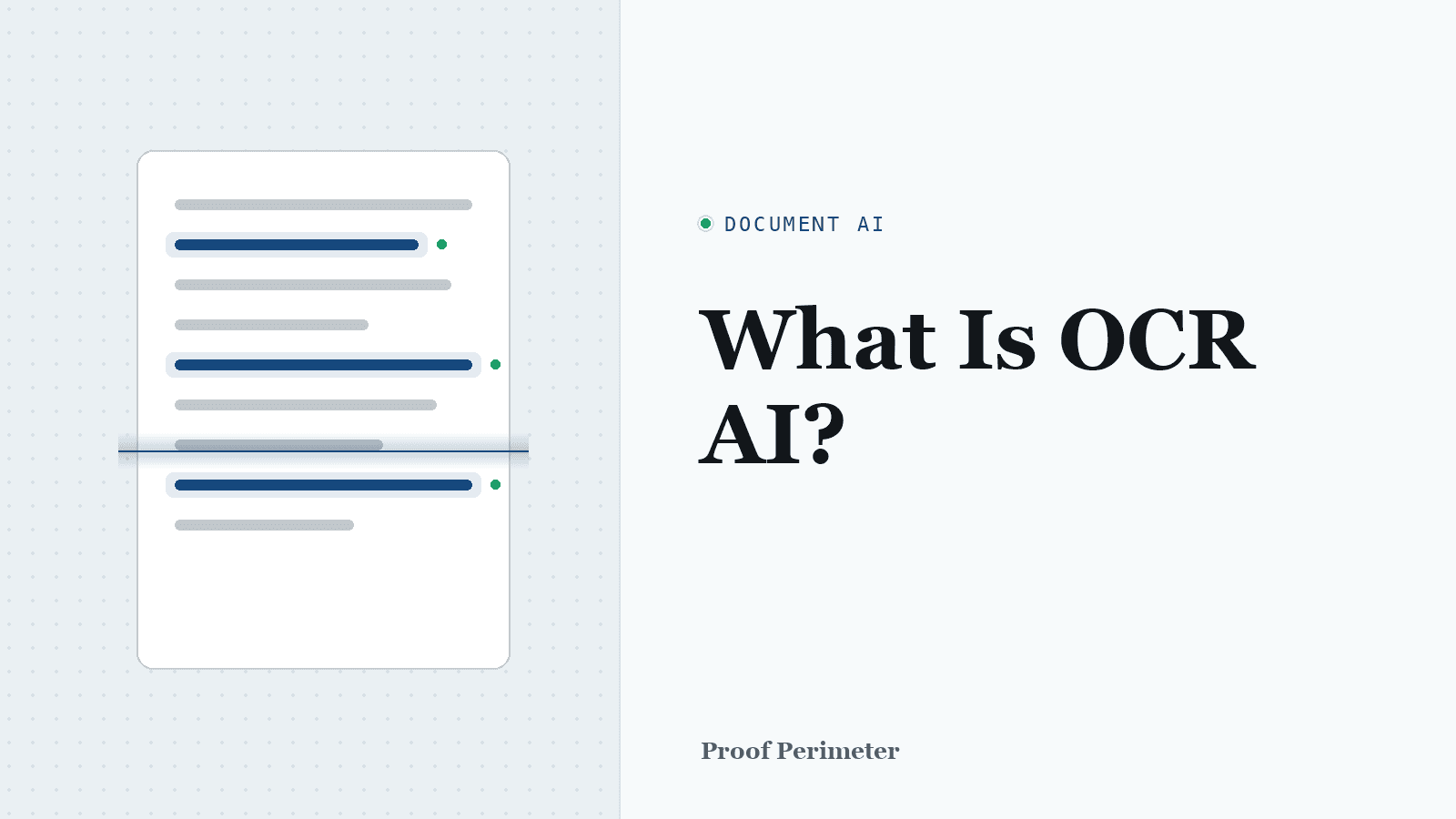
Every enterprise that touches paper — banks, insurers, lenders — eventually runs into the same wall: OCR gets you text, but text isn't the same as an answer. "OCR AI" is the term that's grown up around closing that gap: pairing traditional optical character recognition with machine learning models that can read a document the way a person would, and hand back structured, usable data instead of a wall of characters. This guide walks through what OCR AI actually is, how it differs from classic OCR and rules-based automation, where it's being used today, and what to look for if you're evaluating it for a document-heavy, regulated workflow.
What Is OCR? A Quick Primer
Before OCR AI makes sense, it helps to be precise about what OCR itself does — and doesn't do.
How Traditional OCR Works
Optical character recognition is, at its core, a pattern-matching problem. Given an image of a page, an OCR engine locates individual glyphs, classifies each one against a known character set, and reconstructs the underlying text string. Modern engines refine this with segmentation (splitting a page into lines, words, and characters), language models that bias recognition toward plausible words, and layout analysis that keeps columns and reading order intact.
Engines like Tesseract, ABBYY FineReader, and the OCR modules built into cloud platforms have spent decades getting extremely good at this specific job. Given a reasonably clean scan of a standard document, they can turn it into a searchable, copyable string of characters with very high character-level accuracy. That's a genuinely hard computer vision problem, and it's largely solved for well-behaved inputs.
Where Traditional OCR Falls Short
The limitation isn't recognition accuracy — it's understanding. Classic OCR has no concept of "this is the borrower's name" or "this is the claim amount." It knows there's a sequence of characters at a given pixel location, and that's all it knows. Any structure — turning a page of recognized text into a set of meaningful fields — has to be bolted on afterward, usually with brittle rules: regular expressions, fixed coordinate templates, keyword-proximity heuristics ("the number after the words 'Total Due' is the amount").
That works, until it doesn't. Change the layout of a form, swap in a new vendor's invoice template, receive a slightly rotated or lower-quality scan, and the rules break. Someone has to notice the failure, diagnose it, and patch the template — and that maintenance burden scales linearly with the number of document variants a business processes. For a company handling one invoice format from one vendor, that's manageable. For a bank processing loan files, pay stubs, and identity documents from thousands of different sources, it isn't.
What Is OCR AI?
OCR AI — sometimes called AI-powered OCR, and often used interchangeably with the broader term intelligent document processing (IDP) — adds a second layer on top of raw character recognition: a machine learning model that has learned what documents in a given domain actually look like and mean, not just what characters appear on the page.
From Character Recognition to Document Understanding
Where classic OCR outputs an unstructured stream of text, OCR AI outputs an interpretation. It's the difference between transcribing a page and reading it. The models behind OCR AI are typically vision-language models or document-specific foundation models, trained (or fine-tuned) on large corpora of real documents so they learn the visual and semantic patterns of forms, invoices, contracts, and financial statements — not just how individual characters look, but how a document of that type is typically structured, what fields it tends to contain, and how those fields relate to each other.
This is a meaningful shift in category, not just an incremental accuracy improvement. Classic OCR is a computer vision problem: turn pixels into characters. OCR AI is a document understanding problem: turn pixels into meaning.
How OCR AI Works Under the Hood
Most production OCR AI systems combine several capabilities into a single pipeline, whether that pipeline is one end-to-end model or several specialized stages working together.
Vision-Language Models and Document Foundation Models
The current generation of OCR AI is largely built on vision-language models: architectures that can take an image (or a PDF page rendered as an image) as input alongside a natural-language instruction or schema, and produce structured text as output. Some vendors use general-purpose frontier multimodal models for this; others fine-tune smaller, domain-specific models on document data so the model specializes in forms, tables, and financial or legal documents rather than trying to be good at everything from photographs to memes. That specialization tends to pay off directly in accuracy and cost for narrow, high-volume document types.
Layout and Context Understanding
Instead of reading a page as an unstructured string, the model reasons over layout: tables, headers, checkboxes, signature blocks, multi-column text, and repeating line items. It can tell that a number sitting under a "Loan Amount" header is different from a similarly formatted number under "Account Number," even when the two fields sit right next to each other on the page — something that's genuinely difficult for coordinate-based template rules to get right across many document variants.
Field-Level Extraction, Not Just Text Dumps
Rather than returning "here is all the text on this page," an OCR AI system returns structured output — for example, a JSON object with keys like borrower_name, loan_amount, and issue_date, each mapped to the value the model found. That structured shape is what actually plugs into a downstream workflow — a loan origination system, a claims queue, a KYC review screen — without a human retyping values out of a text blob or a developer writing custom parsing logic for every document type.
Generalization Across Document Variants
Because the model has learned patterns rather than memorized a single template, it holds up far better when documents vary: different bank statement formats, different insurers' claim forms, scanned versus digitally generated PDFs, slightly skewed or noisy scans, documents in different languages. Template-based extraction typically needs a new template built and tested for every variant; a well-trained document AI model handles reasonable variation out of the box, and improves further with targeted fine-tuning on a customer's specific document mix.
Confidence Scoring and Human-in-the-Loop Review
Because no model is perfect, mature OCR AI systems attach a confidence score to each extracted field, not just to the document as a whole. Low-confidence fields — an ambiguous handwritten digit, a smudged stamp, a value that falls outside an expected range — get routed to a human reviewer instead of silently flowing downstream as if they were certain. This maker-checker pattern is what makes OCR AI usable in workflows where an error has real financial or compliance consequences: the model handles the bulk of straightforward extractions automatically, and a person's attention is reserved for the cases that actually need it.
OCR vs. OCR AI vs. Intelligent Document Processing (IDP)
These terms get used inconsistently enough that it's worth being explicit about how they relate:
- OCR is narrowly the conversion of an image into text — character recognition, nothing more.
- OCR AI describes OCR that's paired with a machine learning model capable of understanding structure and meaning, not just characters — the focus of this article.
- Intelligent document processing (IDP) is the broader category: a full pipeline that typically includes document classification (what type of document is this), OCR AI-style extraction, validation against business rules, and often workflow routing to the next system or reviewer.
In practice, most vendors marketing "OCR AI" are really selling a slice of an IDP platform — extraction plus some validation — rather than the narrow OCR-only capability the term technically describes. If you want a deeper, term-by-term breakdown of this space, our AI document processing glossary covers dozens of related concepts in plain language.
Real-World Use Cases of OCR AI
OCR AI has moved well past pilot projects. Here's where it's doing real production work today.
Banking and KYC Verification
Know-your-customer (KYC) onboarding requires pulling structured data — names, addresses, ID numbers, dates of birth — out of a mix of government IDs, passports, utility bills, and proof-of-address documents, often from customers in multiple countries with different document formats. OCR AI extracts these fields automatically and cross-checks them against submitted application data, dramatically cutting the manual review time per application while leaving a clear trail of what was extracted and matched.
Insurance Claims Processing
A single claim can arrive as a bundle of dozens of pages: intake forms, medical or repair invoices, adjuster notes, photos with embedded text, and correspondence. OCR AI classifies each page, extracts the relevant fields per document type, and flags inconsistencies (a claimed amount that doesn't match an itemized invoice, for instance) — work that used to consume hours of adjuster time per claim.
Loan Origination and Underwriting
Loan files bundle pay stubs, tax returns, bank statements, and property or collateral documents, each with its own layout and each varying by lender, employer, or region. OCR AI extracts income, asset, and liability figures directly into underwriting systems, and — critically for compliance-sensitive lending decisions — can preserve a record of exactly which document a given figure came from.
Legal and Contract Review
Contracts, amendments, and regulatory filings are dense, long-form documents where the "fields" of interest are often clauses rather than simple key-value pairs: termination conditions, indemnification language, renewal terms. OCR AI models tuned for this kind of extraction can flag and summarize relevant clauses across a large contract portfolio far faster than manual review, while still routing ambiguous language to a lawyer for a final read.
Healthcare and Government Document Processing
Hospitals, insurers, and public agencies handle enormous volumes of forms that combine typed and handwritten fields — intake forms, prior-authorization requests, benefits applications, permit filings. OCR AI's advantage here is less about raw volume and more about variability: the same form type arrives filled out by hand, typed, scanned at an angle, or photographed on a phone, and the extraction system has to handle all of it without a separate pipeline for each input quality level.
Key Benefits of OCR AI
Across these use cases, the recurring advantages are consistent:
- Speed — documents that took minutes or hours of manual data entry are processed in seconds.
- Consistency — a model applies the same extraction logic every time, without the fatigue-driven errors that creep into repetitive manual data entry.
- Lower per-document cost — once trained or configured for a document type, marginal cost per document drops sharply compared to manual review.
- Better generalization — one model can handle many document variants, reducing the template-maintenance burden that plagues rules-based systems.
- Structured, integration-ready output — extracted fields flow directly into downstream systems instead of requiring a separate parsing or re-keying step.
Challenges and Limitations to Watch For
OCR AI isn't a solved problem, and it's worth going in with clear eyes about where it can still fail.
Hallucination and Confidence Risk
Like any generative model, a vision-language model can produce a plausible-looking but wrong answer — inventing a value rather than correctly reporting that a field is missing or illegible. Without well-calibrated confidence scores and a human-in-the-loop escalation path, this kind of quiet error is far more dangerous than an OCR engine simply failing to recognize a character, because it looks like a correct answer rather than an obvious gap.
Data Privacy and Residency
Many OCR AI products are delivered as a cloud API: you send a document, the vendor's servers process it, and you get structured data back. For everyday business documents that's a non-issue. For KYC packets, medical records, or loan files, it can conflict directly with data residency requirements, contractual confidentiality obligations, or a simple institutional unwillingness to let sensitive documents leave their own infrastructure.
Cost and Latency at Scale
Large, general-purpose multimodal models are computationally expensive to run at the volumes regulated institutions actually operate at — tens of thousands to millions of documents a month. That cost, plus network latency to a third-party API, can make a technically capable OCR AI product impractical at production scale without either aggressive optimization or a smaller, purpose-built model.
Why OCR AI Matters More in Regulated Industries
For banking, insurance, and other regulated financial services, the stakes around document extraction go beyond convenience. A KYC packet, a loan file, or a claims document isn't just data to be extracted — it's evidence that has to hold up to a regulator's scrutiny. That raises requirements generic OCR AI tooling often doesn't meet out of the box.
Accuracy on Your Actual Documents
A benchmark accuracy number on a generic public dataset says very little about how a model will perform on a specific bank's own loan file layouts or a specific insurer's own claim forms. What matters is accuracy on the documents a business actually processes, measured against its own historical data — which typically requires either fine-tuning or careful, document-specific evaluation before rollout.
Provenance: Proving What the Model Saw and Decided
Beyond getting the right answer, regulated workflows need a record of how the answer was reached: what the model saw, what it extracted, and why — field by field, document by document. Without that provenance trail, a correct extraction still isn't defensible in front of an examiner or auditor asking how a specific number ended up in a specific system.
Data Control and Zero-Egress Deployment
Many institutions are bound by regulation, or simple risk appetite, against sending sensitive documents to a third-party cloud API at all. This is the specific gap Proof Perimeter is built to close: small, fine-tuned document AI models that run inside a bank or insurer's own environment — cloud-hosted, within customer infrastructure, or fully on-premise, on commodity CPUs — so document inference never leaves the customer's perimeter, with field-level provenance attached to every extracted value. That combination is what turns OCR AI from a productivity tool into something a compliance team can actually sign off on — see our deeper look at the sovereign AI gap for why data residency alone doesn't close this question.
How to Evaluate an OCR AI Vendor
If you're assessing OCR AI for a document-heavy workflow, a short checklist goes a long way:
- Test on your own documents, not a demo dataset. Accuracy claims are only meaningful against the specific layouts and quality of documents you actually process.
- Ask how confidence scoring works. Field-level confidence, not just an overall document score, is what makes human-in-the-loop review workable.
- Understand the deployment model. Cloud API, VPC deployment, or fully on-premise — match this to your actual data residency and compliance constraints before you fall in love with the accuracy numbers.
- Ask for provenance, not just extraction. Can the vendor show you what the model saw and why it made a given decision, per field, after the fact?
- Model the real cost at your volume. A per-call price that looks reasonable in a pilot can look very different at production document volumes — factor in both API costs and any human review overhead for low-confidence fields.
The Future of OCR AI
The near-term trajectory is toward smaller, more specialized models rather than ever-larger general-purpose ones. Fine-tuned document-understanding models are already matching or beating general frontier models on narrow extraction tasks, at a fraction of the token cost and latency — which matters enormously once you're processing millions of documents rather than demoing dozens. Expect continued progress on handwriting and low-quality scan robustness, tighter integration between extraction and workflow automation (routing, validation, exception handling as part of the same system rather than bolted-on afterward), and — particularly in regulated industries — a growing expectation that provenance and auditability ship as a first-class feature rather than an afterthought. One concrete example of that trajectory already underway: agentic document extraction, where the model checks and corrects its own uncertain reads before they ever reach a reviewer, rather than reporting a single-pass answer regardless of confidence.
Frequently Asked Questions
Is OCR AI the same as intelligent document processing?
Not exactly. OCR AI specifically refers to OCR paired with a model that understands document structure and meaning. Intelligent document processing (IDP) is the broader category that typically bundles OCR AI-style extraction together with document classification, validation, and workflow routing into a single platform.
Can OCR AI read handwriting?
Modern OCR AI models handle handwriting substantially better than classic OCR engines, particularly for structured handwritten fields like dates, dollar amounts, and printed-style signatures. Accuracy still varies with handwriting legibility, and low-confidence handwritten fields are exactly the kind of case that should route to human review rather than flow through automatically.
Is OCR AI accurate enough for regulated industries?
It can be, but "accurate enough" has to be measured against a business's own documents, not a generic benchmark, and paired with field-level confidence scoring, human-in-the-loop review for uncertain cases, and a provenance record that lets an auditor verify how a value was extracted.
Does OCR AI require sending documents to the cloud?
Not necessarily. While many OCR AI products are delivered as cloud APIs, deployment options increasingly include VPC-hosted and fully on-premise models for organizations that need documents to stay entirely within their own environment — a requirement for many banks and insurers handling regulated data.
How is OCR AI priced?
Pricing models vary: per-page or per-document fees, per-API-call pricing tied to token or compute usage, or flat platform licensing for on-premise deployments. At low volumes, per-call cloud pricing is usually the simplest option; at the volumes regulated institutions actually process — tens of thousands to millions of documents monthly — the total cost, including any human review overhead, tends to favor smaller, purpose-built models over general-purpose ones billed by token.
The Takeaway
OCR gets you characters. OCR AI gets you understanding — structured, contextual, field-level data that a downstream system or reviewer can actually use, plus the confidence scoring and provenance that make it trustworthy rather than just fast. For document-heavy regulated workflows, the winning systems aren't just accurate; they're auditable and deployable inside the walls a business already has to operate within.
The Sovereign AI Gap: Data Residency Risk
Data residency rules govern where a document sits — not where the AI model reads it. DORA Article 28 holds financial institutions responsible either way.
Confidence Scoring in Document Extraction
Confidence scoring decides which extracted fields skip review — EU AI Act Article 14 now makes that human oversight a legal duty, not just good practice.
What Is Agentic Document Extraction?
Agentic document extraction adds a self-correcting reasoning loop OCR never had — catching its own errors before they reach a regulated workflow.
Proof Perimeter runs document AI inside your own perimeter — with a provenance record on every field.
Get Started for Free